Direct Democracy TODAY
A Celebration of Swiss Style Direct Democracy

Direct Democracy TODAY
Leading Together
Out NOW exclusively on AMAZON
My novel Enlightened - A Voyage of Discovery I tell the story of Thomas Mercer, a British advisor to start-ups, who never paid much heed to politics.
For most of his life, he viewed political matters as distant concerns that barely brushed the edges of his daily existence.
However, as government decisions began to intrude more intrusively and authoritatively into his personal and professional life, Mercer found himself feeling increasingly disenfranchised.
Like millions of others, he saw his interests overlooked and his voice ignored in a system that seemed to promise much but deliver little in terms of true representation.
This growing sense of alienation set Mercer on an unexpected journey of exploration into the heart of direct democracy—a journey that would take him far from the disillusioning shores of his homeland to the vibrant, participatory political landscape of Switzerland.
His frequent travels to Switzerland as a consultant provided the perfect opportunity to delve deeper into the Swiss model, where he found inspiration and hope amidst the people and their unique democratic processes.
In Switzerland, Mercer encountered a political system starkly different from the one he knew. Here, citizens had a tangible say in their governance through frequent referendums and initiatives, a process that seemed to empower individuals rather than side-line them.
Through conversations with Swiss citizens and political advisors, Mercer came to realize that what he had accepted as democracy was merely a shadow of what true democratic participation could be.
“Enlightened" is the compelling account of Mercer's transformation from a politically apathetic citizen to an ardent advocate for direct democracy.
His narrative is not just a personal journey but a broader exploration of how adopting elements of Swiss-style direct democracy could revitalize political systems elsewhere, including in his home country.
Mercer’s story offers a beacon of hope for those feeling powerless within their current political frameworks, demonstrating that change is possible and that a more engaged and empowered citizenry can lead to a more genuine democracy.
The book is filled with humorous stories and historical insights, offering a virtual tour of Switzerland as the narrative progresses.
().png)
Democracy – Swiss Style “Small is the new big.”
What if the solution to modern political dysfunction wasn’t more power, but less? What if true democracy wasn’t about louder leaders or faster systems — but about bringing decision-making back within human reach?
In Democracy – Swiss Style, Simon Gregory takes readers on a powerful, thought-provoking journey into the heart of Switzerland’s unique political model — one that quietly defies the world’s obsession with centralisation, control, and speed. From the legendary Oath of Rütli in 1291 to the 21st-century debates over globalism and digital governance, this book reveals how a small nation built an enduring democracy rooted in proximity, participation, and trust.
Blending history, political philosophy, and modern commentary, Gregory uncovers why Switzerland consistently ranks among the world’s most successful societies — and what the rest of the world can learn from it. He explores the structures that keep Swiss democracy alive: rotating leadership, citizen referendums, part-time politicians, and a radical decentralisation that disperses power through cantons and communes rather than hoarding it in capitals.
But this is more than a study of governance. It’s a mirror held up to our time — a warning against digital authoritarianism, corporate capture, and the growing distance between citizens and those who rule them. Through vivid storytelling and timely insight, Democracy – Swiss Style argues that Switzerland’s model may be the antidote to the modern democratic malaise: a living proof that freedom, equality, and stability can coexist when people truly govern themselves.
Switzerland’s lesson is simple but revolutionary: when power is close, people care. When decisions are shared, societies thrive. And when democracy is small enough to see its own reflection, it becomes big enough to endure.
£12.99 from Amazon
Grassroots - Dawn of Transformation is about the hero of the book Thomas Mercer who is on a journey to discover how the Swiss govern themselves through the tools of #DirectDemocracy. Tools that are hard-baked into the Swiss political system.
In this book Thomas is surprised to learn how Swiss citizens have the first and last word about how their society is governed in a system that makes the country ranked number one or number two in many global indicators whether it’s to do with low crime rate, trust in government, earnings, health, and happiness. It’s direct democracy that makes the difference.
Grassroots reveals a powerful truth: democracy works best on a human scale. When your councillor is your neighbour, accountability is no longer abstract. You meet decision-makers in the grocery aisle, not behind distant bureaucratic walls.
Problems are solved locally, quickly, and by people who actually live with the consequences.
With 26 autonomous cantons and thousands of communes, Switzerland proves that proximity creates responsibility—and real political power truly belongs to the people.

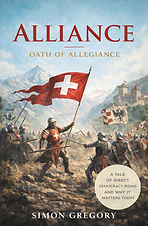
In Alliance – Oath of Allegiance, Simon Gregory delivers a rare political-philosophical exploration wrapped in an entertaining narrative cloak.
At its heart is Thomas Mercer, a sharply observant British start-up advisor who trades pitch decks and venture capital for vineyards and parchment scrolls in an attempt to unearth the historical DNA of Swiss direct democracy. What begins as a personal curiosity quickly evolves into a richly layered quest—part travelogue, part philosophical dialogue, and part subtle indictment of our modern systems of power.
Mercer’s journey—spanning monasteries, dusty archives, and vine-covered hillsides—uncovers uncanny echoes between the resistance of the Swiss confederates to Habsburg imperial creep and the subtle encroachments of today’s supranational governance. Through an encounter with a Benedictine monk, the book’s Socratic anchor, he gains more than a crash course in medieval history. He acquires a lens—clear, unflinching, and deeply relevant—through which to see the parallels between yesterday's empires and today's alphabet soup of global institutions.
What makes Alliance stand out is not just its message but its method. Gregory resists the urge to lecture. Instead, he crafts a novel that is as intellectually rigorous as it is accessible.
With dry wit, keen insight, and the occasional Latin flourish, he makes medieval treaties and philosophical doctrines feel alive, urgent, and—somehow—funny. At no point does the narrative feel bogged down in ideology; rather, it dances gracefully between eras, connecting the dots without condescension.
Perhaps the book’s most striking accomplishment is its final act, where Mercer returns from his historical deep-dive into the thick fog of contemporary politics.
Here, rather than offering a simplistic fix or a manifesto, Alliance provides something rarer: inspiration. It proposes that direct democracy isn't a relic or a regional quirk—it’s a living, breathing antidote to centralised technocracy. In Switzerland’s stubborn decentralisation, Gregory finds not nostalgia, but a blueprint.
This is a novel for readers who suspect that real democracy might mean more than choosing between two pre-selected options every four years. It’s for those tired of curated consensus and yearning for a politics that is not just by the people but truly of them.
In a time when democratic values are brandished like slogans but seldom practised, Alliance – Oath of Allegiance is a timely, thoughtful, and—crucially—hopeful reminder that power can still bubble up from below.
A must-read for fans of Robert Harris, lovers of political thought, and anyone who has ever felt that history just might be whispering warnings—and possibilities—into the noise of the present.

Subsidiarity: Gateway to Democracy - is a thought-provoking and timely read that might just be the summer novel you've been waiting for.
What if democracy isn’t dying—but just needs a good walk?
Subsidiarity takes readers on a vibrant 30-day trek across Switzerland, where four unlikely companions—a former Cistercian monk, a Benedictine dropout, a weathered farmer, and a British start-up advisor—set out on foot to rediscover a radical yet ancient idea: that decisions should be made as close to the people as possible.
Blending laugh-out-loud camaraderie with deep philosophical inquiry, their journey is part pilgrimage, part civic adventure. Along the way, they cross alpine ridges, whisper through forgotten valleys, and encounter poets, prophets, and politicians—some real, others imagined—all offering clues to the enduring power of Swiss direct democracy.
Threaded through their path is a darker vision: a future where democratic governance has quietly been replaced by algorithmic rule and centralized control. Yet amid the looming spectre of digital dystopia, Switzerland stands as a stubborn holdout—and perhaps a guidepost.
This is a story about reclaiming voice, conscience, and community in an age that too often mistakes efficiency for wisdom. Witty, profound, and unexpectedly hopeful,
Subsidiarity is a love letter to localism, liberty, and the belief that freedom, like a mountain trail, is best navigated step by step, together.


Cain - Megalithic City Builder - From the first antediluvian cities to the fifteen-minute surveillance cities of the twenty-first century, Cain – Megalithic City Builder exposes the powers behind power—the forces that have shaped, guided, and manipulated human civilisation across all ages.
This book begins before history as we are taught it. Long before empires, before nations, before written memory fractured into myth, it explores a world remembered in more than two hundred flood traditions scattered across every continent. Are these stories coincidence—or echoes of a single, world-shaping catastrophe?
The narrative draws the reader into the age before the Deluge, a time of giants, advanced knowledge, and cities raised with a purpose far greater than shelter. It follows humanity through the great portal of the Flood into the post-diluvian world, revealing how the builders of the old world did not disappear, but adapted—re-emerging behind new masks, new empires, and new forms of control.
You will encounter the great memorial raised to commemorate the world’s greatest destruction, the rise of Nimrod and the Tower of Babel, the scattering of peoples across the earth, and the emergence of the ancient power centres: Ur, Babylon, Egypt, the Achaemenid Empire, Troy, Greece, Rome, and beyond. The journey continues through the Vatican, dynastic family rule, the City of London, imperial America, the rise of China, supranational institutions, and finally into a technologically enforced dystopia that mirrors the ambitions of the very first city builders.
Stone cities and digital cities are revealed as expressions of the same impulse—one visible, the other invisible, both megalithic in scale. What once required giants and stone now requires data, algorithms, and surveillance. The spirit that animated Cain before the Flood reappears in modern systems designed to govern not land, but behaviour, memory, and identity.
At the heart of the book are fifteen ancient and modern manuscripts, discovered in a hidden Benedictine archive, each acting as a window into a different age. Together they tell a single, unsettling story: civilisation has been guided by a repeating pattern—and we are living at its climax.
Yet this is not a book of despair.
When the system finally overreaches, when the plug is pulled, something ancient and true resurfaces—something older than cities, older than empires, older than stone.
Cain – Megalithic City Builder is a sweeping, provocative exploration of origins, memory, power, and resistance. It invites readers who stand before ancient ruins, who look at impossible stonework, who question official history, and who sense that humanity’s story is far deeper—and far stranger—than we have been told.
You will never look at megaliths, empires, or the modern world in the same way again.

The Swiss Democracy Dictionary
Each entry provides one to three pages of clear accessible explanation, making the book equally useful to the curious layperson, as well as academics, constitutionalists, politicians and anyone interested in how democracy can work differently.
Is it just a party change that is required or is it a system change?
You can make your own decision, however one thing is for sure with Switzerland being one of the most successful and prosperous countries in the world, consistently ranking across a remarkable range of measures, from low crime rate to quality of life, from competitiveness and innovation to economic performance; and from political stability and institutional trust this dictionary will tell you why and will hold up a mirror to your own system.
I will guarantee that you will ask yourself incredulously what system you have been living under because whilst there is no perfect system, to my mind having lived under it for almost two decades Switzerland does it extremely well and its citizens according to various rankings are amongst the happiest in the world.
This dictionary follows – other books I have written on the subject two non-fiction and four novels, and is meant to be an easy guide and reference edition to a system that gives citizens the power to decide and the inconvenient truth that when citizens have the tools of direct democracy in their hands society gets better, it elevates rather than degrades.
That’s not to say Switzerland is perfect; no country is, but there has to be a reason why it ranks so highly in so many global indices.
In just 72 entries this 365-page guide reveals the reason why.
Warning: reading this book may frustrate you — and inspire you in equal measure.
There is no perfect way to govern. But believe me, there is a better way.
This book is the result of years of research, observation and experience from within Switzerland — a country that has been practising a remarkably different form of democracy for generations.
What is well understood in Switzerland remains surprisingly little known beyond its borders. Now, for the first time, I want to reveal what the Swiss already know to a world where democracy is struggling — and invite you to ask a simple question:
Could there be a better way?
